

Align AI with what matters.
High-risk AI forces difficult choices about values, risks, responsibilities and competing interests, and those choices usually stay implicit until something breaks. Vaerce gives you the interactive tools to work through them yourself — surfacing assumptions, challenging blind spots, exploring consequences — and turns your reasoning into decisions your board can defend and requirements your engineers can build to.
How this works
We don't tell you what your ethics are.
We are an AI ethics firm, and we know what that phrase usually buys you: someone else's principles, a framework, a policy template, or a workshop that ends when the slides close. None of it survives the first real trade-off, because the trade-off belongs to you.
Ethics here is not a values statement. It is reaching a decision, knowing who owns it, and turning it into a requirement someone can build.
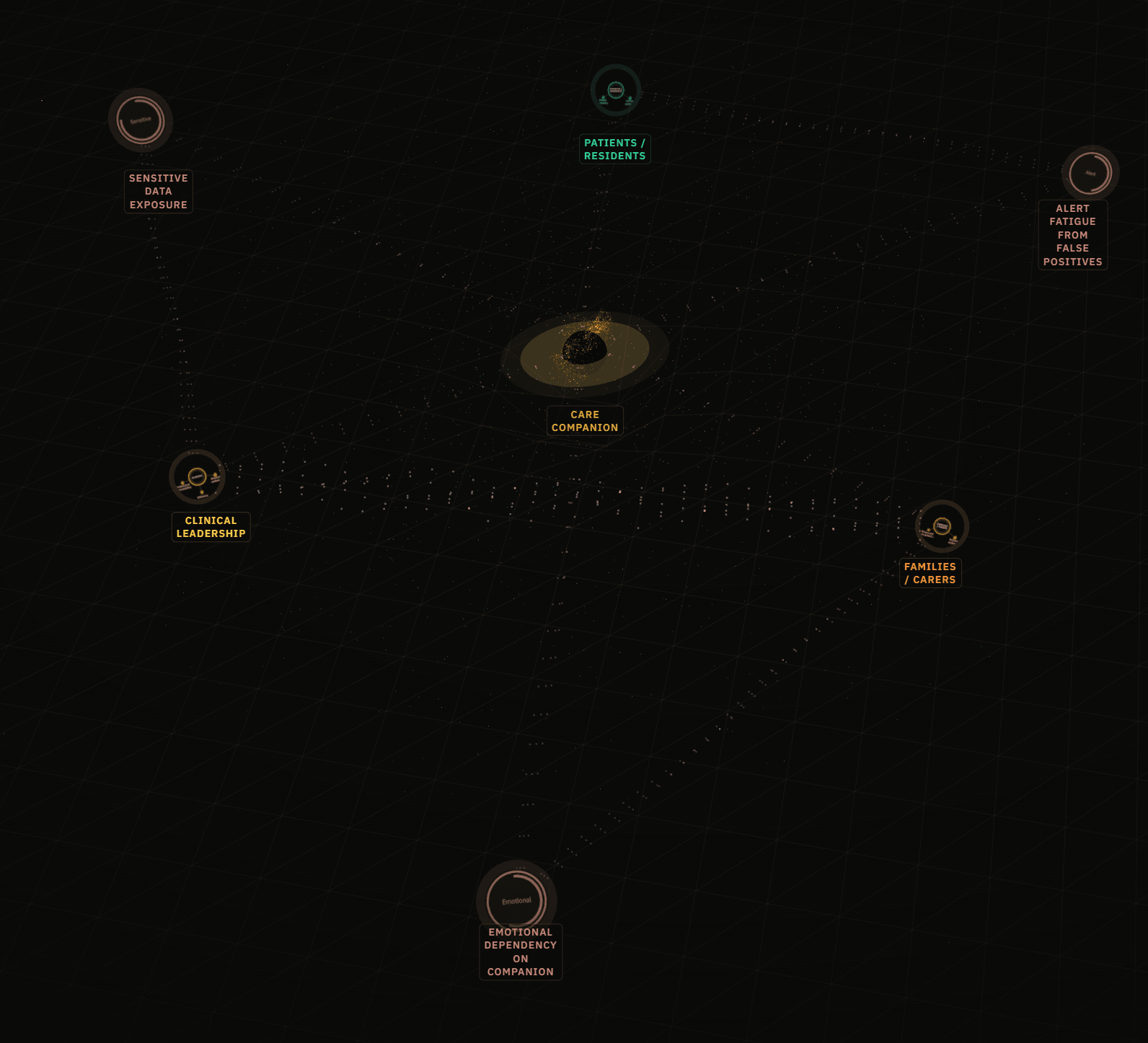
So we built an instrument instead of a framework. Your system sits at the centre of a map; the people it affects are sized by how much weight you give them; your values and risks are placed against each of them. Change what matters most and the map changes with it, in front of the room, while the people who disagree are watching.
To be plain about what that is: the map is software we built, and we operate it in the room with you. The facilitation is ours and the judgement is yours. There is nothing to log into, and no model deciding on your behalf.
We bring those people together, put the competing values on the table, and help you reach a decision grounded in your own context. The result is not a predefined answer. It is a defensible decision, and a record of how you got there.
Where organisations start
Three ways this comes up.
No AI yet, and you want it
You can see the opportunity and you are not willing to accept the harm. Common where the people affected are vulnerable: elderly and patient care, rehabilitation, psychotherapy. We help you decide what you would have to be able to guarantee before you deploy anything at all.
Implementing AI
Triage and prioritisation, discharge planning, documentation and coding, scheduling. The system works; the question is what it changes. We map the organisational consequences: shifted responsibilities, new dependencies, and who absorbs the error, before they land.
Developing AI
You are building the system other people will rely on. Self-help and companion chatbots, assistive products in the home. We turn the value decisions into product requirements your engineers can build to and your board can defend.
Use cases
What this looks like in health.
We work where the people affected are patients, residents and service users. That is where our own research sits, and where being wrong is hardest to reverse. The pattern repeats across all of it. The objectives are clear, the technology works, and the consequences belong to no one.
Elderly and social care
A companion for residents
A care provider wants a chatbot to check in on residents' wellbeing, prompt medication and exercises, and take pressure off nurses who are already short-staffed. The objectives are good and the technology works. What nobody can answer is whether residents come to rely on it instead of a person, whether attachment forms, whether nurses inherit a monitoring job rather than losing a workload, and who is answerable when it misreads distress.
Mental health
No clinician in the loop
A self-help or companion tool reaches people who would never get an appointment, and that is the strongest argument for building it. It is also the argument that makes the hard questions easy to defer: what it does when someone discloses risk at two in the morning, what it is allowed to imply about its own understanding, and whether a person forming an attachment to it is the outcome you wanted or a harm nobody has named.
Hospitals and health systems
Deciding who is seen first
A model helps decide who is seen first, who is ready for discharge, or which referral waits. It performs well against the metrics the business case was built on. The question is whose professional duty it is now entering, what happens to the individual patient when the system is optimising for flow, and which clinician is accountable for a recommendation they did not make and cannot fully explain.
Pharma and life sciences
Automating a regulated workflow
An AI system takes over part of a process that professional judgment used to carry: safety signal review, protocol drafting, patient selection. Throughput improves. The question is where responsibility actually moved, who is accountable for an output nobody authored, and what you tell a regulator who asks which human agreed to it.
Insurance and payers
Customers already using AI for their health
Your customers are making health decisions with consumer tools you do not control and cannot audit. The question is what you are willing to rely on, what you owe someone whose claim was shaped by advice you did not give, and what you refuse to price on even when the signal is sitting there.
No one has the AI playbook.
The only enduring competitive advantage is the capacity to make highly consequential, defensible decisions under uncertainty, when the trade-offs are unavoidable.
Ethics is not new. The conditions are.
Ethics has been part of human decision-making since the beginning of civilisation, and it is still here. What is new is the speed, and the fact that the system now acts.
AI implementation increasingly involves competing priorities, uncertain consequences, and trade-offs that no policy can resolve in advance. Organisations need a way to work through those choices, align the people who are accountable for them, and make decisions they can explain and defend.
The work is practical. Someone has to turn a value like individual autonomy into a requirement a delivery team can ship against, and record why that requirement was accepted, including who disagreed.
Someone has to own the trade-off.
When a system must weigh user privacy against safety monitoring, it cannot resolve that trade-off on its own. Someone must, and that someone has to be named before the system decides.
We make sure that call happens in the boardroom, not in a code repository.
The unnamed decision is the dangerous one. When nobody owns it in advance, ownership gets assigned afterwards, by whoever is most upset, to whoever was closest — and without the reasoning attached. Naming it early, with the justification recorded, is how the people responsible end up protected rather than exposed.
What you leave with
Six outputs. One high-risk application.
Pick one high-risk application — the leverage point you already know matters most. These are not report templates. They are a working instrument you use in the room, and the record it produces afterwards: concrete enough for a board pack and a backlog, and specific enough to answer the question ISO 42001 and the EU AI Act actually ask, which is who decided.
In the session
Value Landscape
Make the decision landscape visible.
Your system at the centre, the people it affects weighted by how much they count, your values and risks placed against each of them. Move a priority and the map moves, so the cost of what you are about to prefer is visible before you commit to it.
OutputAn interactive decision map showing conflicts, dependencies and consequences.
Blind spots
Find what you are missing.
Challenge the assumptions behind your decision and surface overlooked stakeholders, consequences, risks and competing values.
OutputA structured set of blind spots and the questions that could change the decision.
Trade-offs
Turn difficult trade-offs into defensible decisions.
What you will hold, what you will give, and what stays out of scope. Name the risks in play, the consequences if they land, and the mitigations you will actually run.
OutputNamed risks, consequences and mitigations.
After the session
Decision pack
The pack for people who were not in the room.
Bring the decision landscape, blind spots, trade-offs, evidence and reasoning together automatically.
OutputA shared pack for leadership, product and delivery teams.
Comparative market lens
Test your thinking against the outside world.
Compare your decisions with relevant research, regulation, industry practice and emerging developments.
OutputExternal evidence that can challenge, support, or reopen your decision.
Living Decision Record
Keep decisions alive as circumstances change.
Track relevant regulatory, market, research and technology developments, and flag the decisions that may need revisiting.
OutputAn evolving record of what was decided, why, and when to reconsider it.
What we will not do
It tells you when you are not finished.
Most governance tools are built to produce a clean output. Ours is built to refuse one. If the trade-offs are unjustified, a conflict is unresolved, or a limit has never been turned into something testable, the report says so on its first line and lists exactly what is outstanding.
No certificate. No maturity score. No green dashboard implying a question has been settled when it has not. The map illustrates your decision; it does not certify it. You will always be able to tell the difference between what your organisation decided and what the software arranged.
The session
Make the hard calls before you ship.
The facilitated session puts the competing values on the table: what you will spend, what stays off-limits whatever the upside, and the gaps a checklist would miss.
Vague principles collapse under pressure. Transparency. Trust. Fairness. The session forces those words into named duties, justified limits, and testable requirements.
Everyone works from the same map, so a disagreement becomes a thing on a screen that the room can look at together rather than a tension nobody names. When you change what you are willing to prioritise, everyone sees what it costs.
Once the room has a decision, we ask which of its limits will be the first to erode when the targets slip. That is the question that changes what you write down. What cannot survive it is named as unfinished, not papered over.
You leave with the pack: justification recorded, trade-offs explicit, dissent attributed, limits your engineers can ship against.
Handoff
The translation to code.
Named limits and acceptance criteria your delivery team can version and build against. Speed follows once the calls are owned.
Discovery
Map the practice
We define the specific AI application, its role in the organisation, and the professional duties already governing that domain, before system design begins. We establish the boundaries that stay inviolable.
Workshop
Force the trade-offs
Product velocity, compliance and risk management conflict by nature. We surface those tensions explicitly, resolve them through structured opposition, and document the reasoning behind the outcome.
Handoff
Hand off constraints
We hand over a functional blueprint: named limits, acceptance criteria, and the reasoning that produced them. Delivery deploys those constraints. Runtime enforcement with your own engineers is a later engagement if you need it live.
Compare
Playbooks and inventories skip the decision.
Strategy firms sell a playbook that assumes the game holds still. GRC tools fill an inventory that assumes the rules already exist.
Monitoring tools can watch what an agent does once it is live. They cannot tell you who was accountable for what it was allowed to do before it shipped. The session forces that call, and leaves a record you can stand behind.
What all three have in common is that they are paid to tell you that you are covered. We are paid to tell you what you have actually decided, which sometimes means telling you that you have not decided it yet.
Who
Leadership values have to survive impact with the market.
The market will pressure the decision. We write it so leadership can stand behind it and delivery can build to it.

Origin
Before the code, the source.
The name Vaerce is the method: start from the practice, surface opposition, turn decisions into structure.

VER
A new start.
Establish governance from first principles when inherited frames no longer hold.
From the Roman ver sacrum and the Vienna Secession journal of that name: in crisis, leave what no longer holds and found anew.
ERCE
The true starting point.
Establish what is genuine and binding before the system is designed.
From the Old English Æcerbot, a restorative blessing before new work begins, and from erchan: genuine, true, pure.
VERSE
The turning.
Translate board intent into precise requirements engineers can build to.
From Latin versus: the plow's turn that became poetic verse. Structure and meaning in one line.
VERSUS
Opposition.
Surface competing obligations and document the trade-offs before they reach production.
From versus in its other sense: set against. Constructive opposition.
Parse the dense thing, name the core, keep the deeper account underneath. The same move we apply to words like transparency and trust.
Talk before you ship.
No deck, no vendor pitch. Bring the one AI application that is about to act — usually the same one keeping you up at night. We will tell you whether you have a defensible basis to deploy it, and what a handoff would require. Confidential, for executive teams anywhere the cost of being wrong is high and hard to reverse.
Engagements are deliberately narrow: one application, a scope fixed before we begin, and a timeline measured in weeks rather than quarters.